Level 1, 206 Adelaide Terrace, Perth WA 6004
230 Railway Parade, Cannington WA 6107
 Best Accountant Perth | Accounting Firms in PerthBest Accountant Perth | Accounting Firms in Perth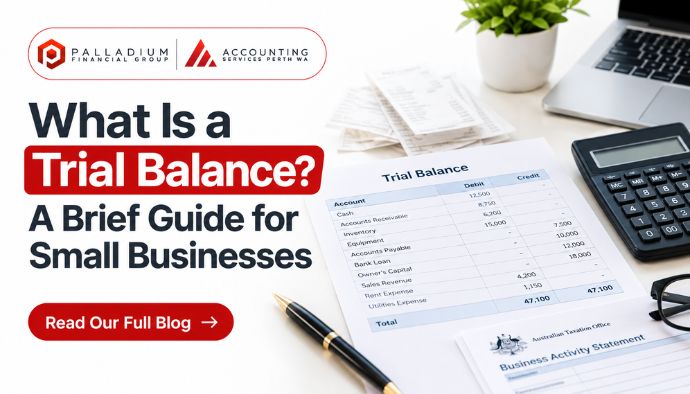
When you run a small business, it is easy to focus on the figures that appear most often: sales, expenses, bank balances and tax payments. Behind those figures, however, is a system of accounting records that needs to remain accurate and consistent.
One of the reports used to check those records is a trial balance.
A trial balance brings together the balances from a business’s ledger accounts at a particular point in time. It gives the business owner, bookkeeper or accountant a convenient way to review the accounts before preparing financial statements or carrying out further accounting work.
But a trial balance is more than just a list of numbers. Understanding what it shows, what it does not show and how it fits into the accounting process can help Australian small business owners make better sense of their financial records.
A trial balance is a report containing the balances of the accounts recorded in a business’s general ledger.
These accounts can include:
The balances are normally shown in debit and credit columns.
Under double-entry bookkeeping, every transaction has corresponding debit and credit entries. When the ledger balances are brought together, the total debits should equal the total credits.
If they do not, there may be an error in the accounting records that needs to be investigated.
A trial balance is therefore an important part of the checking process within business accounting.
A trial balance is mainly a checking point in the accounting process.
It allows someone reviewing the accounts to see the balances of multiple ledger accounts in one place instead of examining every individual transaction separately.
For a small business, this can be useful when preparing financial reports, reviewing bookkeeping work or getting accounts ready for year-end.
It can also make it easier to spot figures that look unusual. An expense account that is significantly higher than expected, for instance, may deserve further investigation even when the trial balance itself balances.
The process begins with individual transactions being recorded in the accounting system.
Suppose a Perth business purchases office furniture for $1,500 and pays from its business bank account.
The transaction could be recorded as:
The two sides are equal.
The same principle applies to other transactions. When all transactions for the relevant period have been posted to the ledger, the closing balance of each account can be included in the trial balance.
The resulting report gives a summary of the ledger at that point in time.
Imagine a small Australian business has the following balances at the end of a month:
| Account | Debit | Credit |
|---|---|---|
| Bank | $18,000 | — |
| Equipment | $7,000 | — |
| Advertising expense | $2,000 | — |
| Rent expense | $3,000 | — |
| Sales | — | $22,000 |
| Owner’s equity | — | $8,000 |
| Total | $30,000 | $30,000 |
The two columns agree, so the trial balance is mathematically balanced.
That does not mean the business has automatically confirmed that every transaction has been recorded correctly. It simply means the debit and credit balances agree based on the entries that have been made.
That distinction is important.
A trial balance provides a useful checkpoint between recording transactions and preparing financial reports.
For a small business, it can help with several parts of the accounting process.
A trial balance provides a quick way to see whether the debit and credit balances agree.
If the totals do not match, the accounting records can be reviewed to find the source of the difference.
The balances shown in a trial balance can be used when preparing financial statements such as the profit and loss statement and balance sheet.
These reports can give a business owner a clearer picture of income, expenses, assets, liabilities and equity.
A trial balance can also make unusual balances easier to spot.
For example, an unexpectedly high expense, an unusual bank balance or an unexpected liability may prompt further investigation.
This is one reason accurate bookkeeping services can be valuable for businesses that do not have the time or resources to review their accounts themselves.
No.
This is an important point for business owners to understand.
A trial balance confirms that the recorded debit and credit balances agree. It does not confirm that every transaction has been classified, entered or interpreted correctly.
For example, suppose a business purchases equipment but records it under an ordinary expense account. The debit and credit entries may still match, so the trial balance can remain balanced.
Other errors may include:
For this reason, a trial balance should be treated as a checking tool rather than a guarantee that the accounts contain no errors.
The accuracy of a trial balance depends heavily on the quality of the bookkeeping behind it.
If transactions are entered incorrectly, accounts are not reconciled or supporting records are missing, the trial balance may not provide a reliable picture of the business.
Good bookkeeping involves more than entering sales and expenses. It includes keeping financial records organised and making sure transactions are posted to appropriate accounts.
For businesses that need ongoing assistance, professional bookkeeping services Perth businesses use can help keep accounting records up to date and ready for review.
Regular bookkeeping can also make it easier to identify discrepancies before they become larger problems.
A trial balance and a balance sheet are connected, but they are not the same report.
A trial balance lists the balances of accounts recorded in the general ledger. Its main purpose is to help check the accounting records and provide information for preparing financial statements.
A balance sheet, also known as a statement of financial position, shows the business’s assets, liabilities and equity at a particular date.
In simple terms:
Trial balance:
A summary of ledger account balances.
Balance sheet:
A financial statement showing the business’s financial position.
The trial balance can be used during the process of preparing a balance sheet, but it does not replace it.
A profit and loss statement has a different purpose.
It focuses on income and expenses over a particular period and shows whether the business generated a profit or loss.
A trial balance contains a wider range of accounts, including assets, liabilities, equity, income and expenses.
This means the trial balance can provide information used in preparing both the profit and loss statement and the balance sheet.
For a small business owner, understanding this difference can make financial reports much easier to interpret.
Australian businesses need to keep appropriate records to support their tax and reporting obligations.
A trial balance can assist with reviewing the accounting information that feeds into financial reporting and, where relevant, tax and GST calculations.
However, a trial balance is not a tax return and does not determine the correct tax treatment of every transaction.
Supporting documents remain important. Depending on the transaction, these may include invoices, receipts, bank records and other business documents.
For a GST-registered business, accurate accounting records can also make it easier to review GST-related transactions before relevant reporting is completed.
This is where proper business accounting and bookkeeping processes can make a practical difference.
There is no single schedule that applies to every small business.
A trial balance may be prepared as part of:
The more regularly accounts are reviewed, the sooner unusual transactions or bookkeeping errors may be noticed.
A business does not necessarily need to prepare the report manually each time. Modern accounting software can generally generate a trial balance based on the information recorded in the system.
Yes.
Most modern accounting platforms can generate a trial balance automatically.
Once transactions have been entered and posted to the relevant accounts, the software can calculate the account balances and produce the report.
This can save considerable time, particularly for businesses with a large number of transactions.
But automation does not mean the information is automatically correct.
If an invoice has been posted to the wrong account, for example, the software will generally use the information it has been given. The resulting trial balance may still balance even though the accounting treatment needs to be reviewed.
That is why software works best alongside sound bookkeeping and regular account reviews.
A useful review should go beyond checking whether the two columns have matching totals.
A business owner or accountant may also look at whether individual balances appear reasonable.
Some areas worth checking include:
These checks can uncover issues that a basic debit-and-credit comparison will not necessarily reveal.
If the debit and credit totals do not agree, the cause can sometimes be relatively simple.
For example, a transaction may have been entered on one side only, an incorrect amount may have been posted, or a ledger balance may have been calculated incorrectly.
Other errors are harder to identify because they may not affect the final totals.
A transaction recorded in the wrong account can still produce a balanced trial balance. So can certain errors where an incorrect amount has been entered on both sides.
This is why a proper review of the underlying records remains important.
A trial balance is only as useful as the accounting information behind it.
If sales, expenses, payments and other transactions are not recorded properly, reports generated from those records may not give the business owner a reliable picture of the business.
This is why small business accounting services can be useful for owners who want their financial records maintained consistently.
Professional support may include maintaining accounting records, reconciling accounts, reviewing transactions and helping prepare financial information for reporting purposes.
For a growing business, having organised records can also make it easier to understand cash flow and financial performance.
Not every business owner needs to prepare a trial balance personally.
Accounting software can generate the report, while a bookkeeper or accountant may handle the review as part of the business’s regular accounting process.
However, knowing what the report means is still useful.
When an accountant discusses a trial balance with a business owner, it helps to understand that the report is essentially a summary of the balances in the accounting ledger. It is one of the checkpoints used to review the accounts before further financial reporting work is completed.
As a business becomes more established, its accounting records often become more detailed.
There may be multiple bank accounts, loans, employees, assets, GST transactions and different types of operating expenses to manage.
Professional accounting services Perth businesses rely on can assist with maintaining financial records, reviewing account balances and making sure the bookkeeping information is ready for further accounting work.
For businesses looking for broader support, small business accountants can also help owners understand their financial reports and maintain a more consistent accounting process.
The aim is not simply to make the trial balance balance. The underlying records need to make sense as well.
Also read: 20 Tax Deductions Australians Can Claim in 2026: A Complete ATO Guide
A trial balance is a straightforward accounting report, but it plays an important role in checking a business’s financial records.
It brings together the balances from the general ledger and checks whether the total debits and credits agree. It can also provide useful information when preparing financial statements and reviewing the accounts.
At the same time, a balanced trial balance does not prove that every transaction has been recorded correctly. Proper bookkeeping, account reconciliation and review of supporting records are still necessary.
For Australian small businesses, maintaining reliable financial records makes it easier to understand business performance and keep accounting information organised. A trial balance is one part of that wider process, helping connect day-to-day bookkeeping with the financial reports used to understand the business.
1. Is a trial balance required by law for Australian small businesses?
No. Australian small businesses are not generally required to prepare a trial balance as a standalone report. It is primarily an internal accounting tool used to check ledger balances and support the preparation and review of financial reports.
2. What is the difference between an adjusted and unadjusted trial balance?
An unadjusted trial balance is prepared before accounting adjustments are made. An adjusted trial balance is prepared after adjustments such as accrued expenses, depreciation or other end-of-period entries have been recorded. The adjusted version is then used for further financial reporting.
3. Can a trial balance be prepared for a sole trader?
Yes. A sole trader can have a trial balance prepared from their accounting records. It can help organise ledger balances and provide a useful starting point for reviewing the business’s financial information.
4. What happens if a trial balance does not balance?
If the debit and credit totals do not agree, the accounting records should be investigated before relying on the report. The difference may result from a missing entry, incorrect amount, posting error or another bookkeeping issue.
5. How often should a small business review its trial balance?
The appropriate frequency depends on the size and activity of the business. Some businesses may review their trial balance monthly, while others may do so quarterly or at key reporting periods. Regular reviews can help identify unusual account balances or recording issues earlier.