Level 1, 206 Adelaide Terrace, Perth WA 6004
230 Railway Parade, Cannington WA 6107
 Best Accountant Perth | Accounting Firms in PerthBest Accountant Perth | Accounting Firms in Perth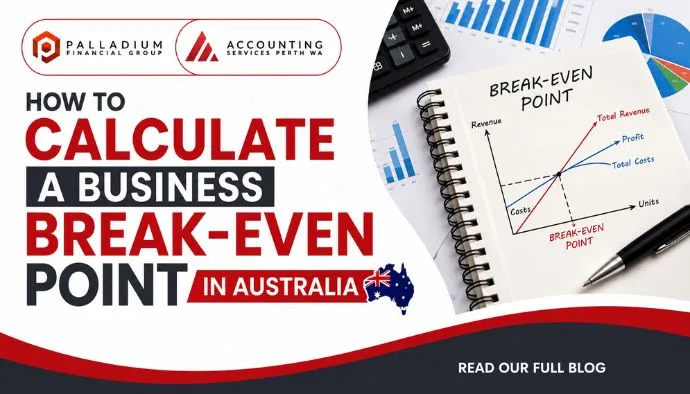
Do you know how much your business needs to sell each month before it actually starts making money?
Many Australian business owners focus heavily on revenue. A strong sales month can look encouraging, but revenue alone does not tell you whether the business is covering everything it costs to operate. Rent, wages, software, insurance, materials, merchant fees and other expenses can quickly reduce what appears to be a healthy income.
A break-even calculation gives you a clearer picture.
Your business break-even point is the level of sales required to cover your costs. Below that level, the business is operating at a loss. Above it, each additional sale can contribute towards profit, provided your assumptions remain reasonable.
For Australian businesses, this calculation can be a useful part of budgeting, pricing decisions, cash flow planning and broader financial management.
Break-even is the point where your business has generated enough revenue to cover the costs included in your calculation.
In simple terms:
Sales revenue = Business costs
There is no profit at this stage, but there is no operating loss either.
Imagine a small Perth business needs $15,000 each month to cover its relevant operating costs. If its sales generate $15,000 during that period, it has reached its break-even level.
If sales rise to $20,000, the business may have room to generate a profit. If sales are only $12,000, there is still a $3,000 gap to cover.
This makes break-even particularly useful when setting realistic sales targets.
A break-even figure can turn a vague financial goal into a measurable target.
Instead of simply deciding that sales need to “increase”, a business owner can work out how many customers, jobs, subscriptions or products are needed to cover costs.
The calculation can also help when making decisions such as whether to:
It is also useful when reviewing whether the current business model is producing enough margin to support long-term growth.
The accuracy of a break-even calculation depends heavily on how you classify your costs.
There are two broad categories to consider: fixed costs and variable costs.
Fixed costs are expenses that generally do not move directly with each individual sale.
Depending on your business, these could include office rent, insurance, accounting software, certain salaries, subscriptions and other regular overheads.
They may change over time, but they are generally not directly linked to the number of units sold.
Variable costs tend to increase as your sales or production increase.
For example, a retailer may have to purchase more stock when it sells more products. A trades business may incur additional materials and subcontractor expenses as more jobs are completed.
Some businesses also have semi-variable costs, meaning part of the expense is fixed while another part changes with activity.
Getting this distinction right is important because the wrong cost assumptions can produce a misleading break-even figure.
For a business selling one main product or service, the standard formula is:
Break-even sales units = Fixed costs ÷ Contribution per sale
Your contribution per sale is calculated as:
Selling price per sale − Variable cost per sale
For example, if a service is sold for $300 and the direct variable cost is $90, the contribution is:
$300 − $90 = $210
If the business has $10,500 of relevant fixed costs for the month:
$10,500 ÷ $210 = 50 sales
The business therefore needs approximately 50 sales during that month to reach break-even under those assumptions.
Consider a fictional Perth-based consulting business charging clients $500 for a standard service package.
Its monthly fixed overheads total $14,000.
The business estimates that each client creates approximately $100 in variable costs through external services, payment costs and other delivery expenses.
The contribution from each client is therefore:
$500 − $100 = $400
Now calculate the break-even number:
$14,000 ÷ $400 = 35 clients
So the business needs approximately 35 clients per month to cover the costs included in this example.
If it consistently serves more than 35 clients, the additional contribution can start building operating profit. If it regularly falls below that level, the owner may need to examine pricing, expenses, sales volume or the overall business model.
You do not always need to think about break-even in terms of individual units or customers.
You can also calculate the required sales revenue.
The contribution margin ratio is:
Contribution per sale ÷ Selling price
Using the previous example:
$400 ÷ $500 = 80%
The business has an 80% contribution margin ratio.
Its break-even revenue would therefore be:
$14,000 ÷ 80% = $17,500
That means the business needs approximately $17,500 in monthly sales revenue to reach break-even under these assumptions.
This method can be particularly helpful for businesses where individual transactions vary in size.
Real businesses are rarely as simple as one product at one price.
A café might sell coffee, breakfast and lunch. An online business might have several subscription plans. A professional firm may offer services at different rates.
When there are multiple products or services, the break-even calculation needs to consider the expected sales mix.
For example, a business cannot assume that every customer purchases its highest-margin service. If most customers choose a lower-priced option, the actual contribution may be considerably different.
Using historical sales data can help create a more realistic estimate.
GST is an important consideration for Australian businesses.
If your business is registered for GST, you generally need to distinguish between the underlying business revenue and GST collected from customers. GST collected is generally not treated as ordinary business income for profitability analysis because it is collected on behalf of the Australian Taxation Office, subject to the applicable GST rules and your GST position.
For internal management reporting, figures are commonly assessed excluding GST so that the calculation reflects the underlying economics of the sale and expense.
However, the correct treatment depends on your accounting circumstances, so consistency is important when preparing financial reports and analysing business performance.
Reaching break-even is a useful milestone, but it should not automatically be treated as a healthy profit target.
A business could technically cover its operating costs while still having very little money available for:
For that reason, business owners should usually aim for a sales level above break-even.
Think of break-even as your minimum operating benchmark, rather than the ultimate financial goal.
This distinction is particularly important for Australian small businesses.
A business may appear profitable on its financial reports but still experience periods of cash shortages.
For example, suppose you invoice a customer for $10,000. The income may be recognised according to the applicable accounting treatment, but if the customer does not pay for 60 days, that money is not immediately available in your bank account.
Meanwhile, wages, rent, suppliers and other bills may need to be paid on time.
This is why break-even analysis should be considered alongside cash flow forecasting.
Accurate bookkeeping services Perth businesses rely on can also help maintain organised financial records, making it easier to monitor revenue, expenses and changes in business performance.
Pricing has a major impact on break-even.
Suppose your selling price is $200 and your variable cost is $80.
Your contribution is:
$200 − $80 = $120
If you increase the selling price to $230 while the variable cost remains $80, the contribution becomes:
$230 − $80 = $150
You now generate more contribution from each sale.
That means fewer sales may be required to cover the same fixed costs.
However, pricing should never be changed simply because a formula suggests that a higher price would improve your margins. You also need to consider your customers, competitors, market conditions and the value your product or service provides.
The opposite can happen when expenses rise.
Suppose your rent increases, wages rise or suppliers charge more for materials. Your fixed or variable costs may increase, pushing your break-even point higher.
This is one reason why a break-even calculation should be reviewed rather than calculated once and forgotten.
Australian businesses may experience changing costs because of wage movements, supplier pricing, insurance premiums, rent increases and other operating changes.
If your break-even target has gradually increased over time while sales have stayed flat, it may be time to examine your cost structure.
A useful way to apply break-even analysis is to test different scenarios before committing to a major business decision.
Suppose you are considering hiring another employee. Rather than looking only at the employee’s salary, consider the full additional cost and calculate how much extra revenue the business would need to generate to make the decision financially worthwhile.
The same approach can be applied when considering new premises, purchasing equipment or introducing a new service. Break-even analysis helps you understand how much additional sales or revenue may be required before the investment begins to make financial sense.
This gives you a more practical way to assess whether a proposed change is affordable and whether it is likely to support your business goals.
There is no need to recalculate your break-even figure every day, but it should be revisited whenever your financial circumstances change materially.
Consider reviewing it when you:
A monthly or quarterly review can also be incorporated into your wider financial management routine.
An experienced accountant Perth businesses work with can help interpret the numbers and identify what the figures mean for pricing, profitability and future planning.
A break-even calculation can look precise while still being based on poor assumptions.
One common mistake is leaving out smaller recurring expenses. Individually, software subscriptions, transaction charges and administrative costs may not look significant, but collectively they can affect your results.
Another mistake is using outdated figures. If your supplier prices or wages have changed, an old calculation may no longer reflect your current position.
Some owners also assume that every sale generates the same margin. That may not be true when a business has different products, services, discounts or customer types.
Finally, do not confuse break-even with profitability. Your business needs to move beyond break-even to generate a meaningful return.
Once you have calculated your break-even point, make it practical. If your business needs 40 sales per month to break even, you could set a target above that figure. Effective business accounting can help you monitor your actual sales, costs, and margins each month, making it easier to see whether the business is moving towards its financial goals. You can then compare:
Actual sales vs break-even sales
and
Actual contribution vs expected contribution
This creates a simple framework for tracking whether the business is moving towards its financial objectives.
Your accounting services provider in Perth can also help you use financial reports to monitor trends rather than relying solely on your bank balance.
Also read: 5 Costly Financial Habits Holding Australian Businesses Back
Calculating your business break-even point gives you something every business owner needs: a clearer understanding of how much the business needs to sell before it can start generating profit.
The calculation starts with three important figures: your fixed costs, your variable cost per sale and your selling price. From there, you can determine the contribution generated by each sale and work out the sales volume or revenue needed to cover your costs.
But the real benefit goes beyond the formula. Break-even analysis can help you evaluate pricing, control expenses, set realistic sales targets and assess whether major business decisions are financially sustainable.
For Australian businesses, it is also important to consider GST, cash flow, record keeping and the broader tax and accounting position when reviewing financial performance.
A break-even figure is not a guarantee of profitability, but it is a valuable benchmark. When reviewed regularly and combined with accurate financial information, it can help you make business decisions with greater confidence.